摘要
初步理解一下: 对于一组输入,根据这个输入,输出有多种可能性,需要计算每一种输出的可能性,以可能性最大的那个输出作为这个输入对应的输出。
那么,如何来解决这个问题呢?
贝叶斯给出了另一个思路。根据历史记录来进行判断。
思路是这样的:
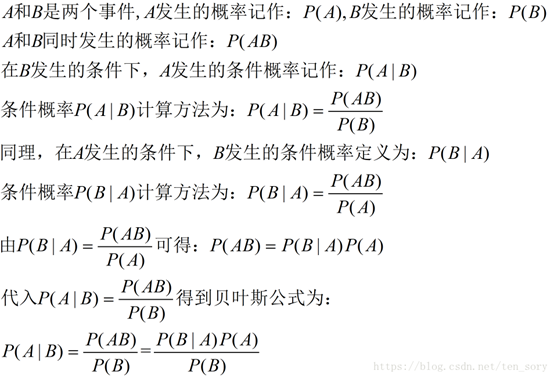
1、根据贝叶斯公式:P(输出|输入)=P(输入|输出)*P(输出)/P(输入)
2、P(输入)=历史数据中,某个输入占所有样本的比例;
3、P(输出)=历史数据中,某个输出占所有样本的比例;
4、P(输入|输出)=历史数据中,某个输入,在某个输出的数量占所有样本的比例,例如:30岁,男性,中午吃面条,其中【30岁,男性就是输入】,【中午吃面条】就是输出。
条件概率的定义与贝叶斯公式
朴素贝叶斯分类算法
朴素贝叶斯是一种有监督的分类算法,可以进行二分类,或者多分类。一个数据集实例如下图所示:
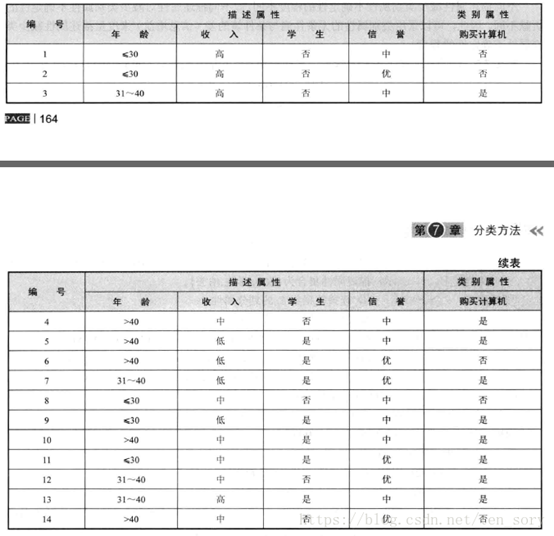
| 现在有一个新的样本, X = (年龄:<=30, 收入:中, 是否学生:是, 信誉:中),目标是利用朴素贝叶斯分类来进行分类。假设类别为C(c1=是 或 c2=否),那么我们的目标是求出P(c1 | X)和P(c2 | X),比较谁更大,那么就将X分为某个类。 |
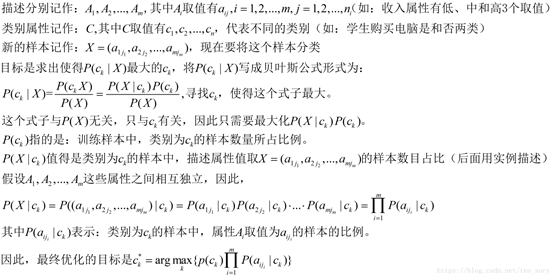
下面,公式化朴素贝叶斯的分类过程。
实例
下面,将下面这个数据集作为训练集,对新的样本X = (年龄:<=30, 收入:中, 是否学生:是, 信誉:中) 作为测试样本,进行分类。
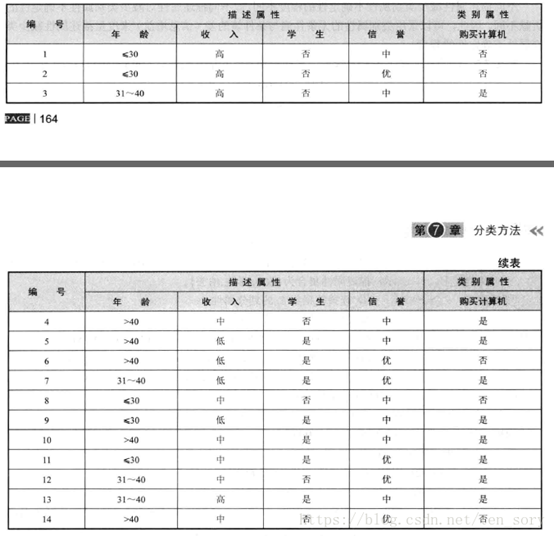
我们可以将这个实例中的描述属性和类别属性,与公式对应起来,然后计算。
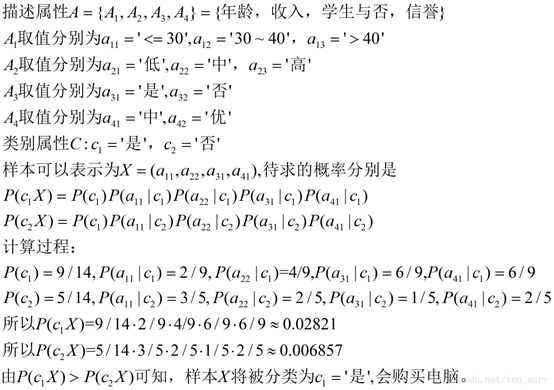
参考python实现代码
#coding:utf-8
# 针对 “买电脑”实例进行朴素贝叶斯分类

#判断变量类型的函数
def typeof(variate):
    type=None
    if isinstance(variate,int):
        type = "int"
    elif isinstance(variate,str):
        type = "str"
    elif isinstance(variate,float):
        type = "float"
    elif isinstance(variate,list):
        type = "list"
    elif isinstance(variate,tuple):
        type = "tuple"
    elif isinstance(variate,dict):
        type = "dict"
    elif isinstance(variate,set):
        type = "set"
    return type

if __name__ == '__main__':

    # 描述属性分别用数字替换
    # 年龄, <=30-->0, 31~40-->1, >40-->2
    # 收入, '低'-->0, '中'-->1, '高'-->2
    # 是否学生, '是'-->0, '否'-->1
    # 信誉: '中'-->0, '优'-->1
    # 类别属性用数字替换
    # 购买电脑是-->0, 不购买电脑否-->1
    MAP = [{'<=30': 0, '31~40': 1, '>40': 2},
           {'低': 0, '中': 1, '高': 2},
           {'是': 0, '否': 1},
           {'中': 0, '优': 1},
           {'是': 0, '否': 1}]

    # 训练样本
    train_samples = ["<=30 高 否 中 否",
                     "<=30 高 否 优 否",
                     "31~40 高 否 中 是",
                     ">40 中 否 中 是",
                     ">40 低 是 中 是",
                     ">40 低 是 优 否",
                     "31~40 低 是 优 是",
                     "<=30 中 否 中 否",
                     "<=30 低 是 中 是",
                     ">40 中 是 中 是",
                     "<=30 中 是 优 是",
                     "31~40 中 否 优 是",
                     "31~40 高 是 中 是",
                     ">40 中 否 优 否"]

    # 下面步骤将文字,转化为对应数字
    # print(typeof(train_samples)) # list
    # print(train_samples) # ['<=30 高 否 中 否', '<=30 高 否 优 否', '31~40 高 否 中 是', '>40 中 否 中 是', '>40 低 是 中 是', '>40 低 是 优 否', '31~40 低 是 优 是', '<=30 中 否 中 否', '<=30 低 是 中 是', '>40 中 是 中 是', '<=30 中 是 优 是', '31~40 中 否 优 是', '31~40 高 是 中 是', '>40 中 否 优 否']
    train_samples = [sample.split(' ') for sample in train_samples]
    # print(typeof(train_samples[1])) # list
    # print(train_samples[1])  # ['<=30', '高', '否', '优', '否']
    # print(typeof(train_samples)) # list
    # print(train_samples) # [['<=30', '高', '否', '中', '否'], ['<=30', '高', '否', '优', '否'], ['31~40', '高', '否', '中', '是'], ['>40', '中', '否', '中', '是'], ['>40', '低', '是', '中', '是'], ['>40', '低', '是', '优', '否'], ['31~40', '低', '是', '优', '是'], ['<=30', '中', '否', '中', '否'], ['<=30', '低', '是', '中', '是'], ['>40', '中', '是', '中', '是'], ['<=30', '中', '是', '优', '是'], ['31~40', '中', '否', '优', '是'], ['31~40', '高', '是', '中', '是'], ['>40', '中', '否', '优', '否']]
    # exit()
    train_samples = [[MAP[i][attr] for i, attr in enumerate(sample)] for sample in train_samples]
    # print(train_samples) # [[0, 2, 1, 0, 1], [0, 2, 1, 1, 1], [1, 2, 1, 0, 0], [2, 1, 1, 0, 0], [2, 0, 0, 0, 0], [2, 0, 0, 1, 1], [1, 0, 0, 1, 0], [0, 1, 1, 0, 1], [0, 0, 0, 0, 0], [2, 1, 0, 0, 0], [0, 1, 0, 1, 0], [1, 1, 1, 1, 0], [1, 2, 0, 0, 0], [2, 1, 1, 1, 1]]

    # 待分类样本
    X = '<=30 中 是 中'
    X = [MAP[i][attr] for i, attr in enumerate(X.split(' '))]

    # 训练样本数量
    n_sample = len(train_samples)
    # print(n_sample) # 14

    # 单个样本的维度: 描述属性和类别属性个数
    dim_sample = len(train_samples[0])
    # print(dim_sample) # 5

    # 计算每个属性有哪些取值
    attr = []
    for i in range(0, dim_sample):
        attr.append([])

    # print(attr) # [[], [], [], [], []]

    for sample in train_samples:
        for i in range(0, dim_sample):
            if sample[i] not in attr[i]:
                attr[i].append(sample[i])

    # print(attr) # [[0, 1, 2], [2, 1, 0], [1, 0], [0, 1], [1, 0]]

    # 每个属性取值的个数
    n_attr = [len(attr) for attr in attr]
    # print(n_attr) # [3, 3, 2, 2, 2]

    # 记录不同类别的样本个数
    n_c = []
    for i in range(0, n_attr[dim_sample - 1]):
        n_c.append(0)
    # print(n_c) # [0, 0]

    # 计算不同类别的样本个数 不同分类包含有无电脑
    for sample in train_samples:
        n_c[sample[dim_sample - 1]] += 1
    # print(n_c) # [9, 5]

    # 计算不同类别样本所占概率
    p_c = [n_cx / sum(n_c) for n_cx in n_c]
    # print(p_c) # [0.6428571428571429, 0.35714285714285715]

    # 将用户按照类别分类
    samples_at_c = {}
    for c in attr[dim_sample - 1]:
        samples_at_c[c] = []
    # print(samples_at_c) # {1: [], 0: []}
    for sample in train_samples:
        samples_at_c[sample[dim_sample - 1]].append(sample)
    # print(samples_at_c) # {1: [[0, 2, 1, 0, 1], [0, 2, 1, 1, 1], [2, 0, 0, 1, 1], [0, 1, 1, 0, 1], [2, 1, 1, 1, 1]], 0: [[1, 2, 1, 0, 0], [2, 1, 1, 0, 0], [2, 0, 0, 0, 0], [1, 0, 0, 1, 0], [0, 0, 0, 0, 0], [2, 1, 0, 0, 0], [0, 1, 0, 1, 0], [1, 1, 1, 1, 0], [1, 2, 0, 0, 0]]}

    # 记录 每个类别的训练样本中,取待分类样本的某个属性值的样本个数
    n_attr_X = {}
    for c in attr[dim_sample - 1]:
        n_attr_X[c] = []
        for j in range(0, dim_sample - 1):
            n_attr_X[c].append(0)
    # print(len(range(0, dim_sample - 1))) # 4
    # print(n_attr_X) # {1: [0, 0, 0, 0], 0: [0, 0, 0, 0]}

    # 计算 每个类别的训练样本中,取待分类样本的某个属性值的样本个数
    for c, samples_at_cx in zip(samples_at_c.keys(), samples_at_c.values()):
        for sample in samples_at_cx:
            for i in range(0, dim_sample - 1):
                if X[i] == sample[i]:
                    n_attr_X[c][i] += 1
    # print(n_attr_X) # {1: [3, 2, 1, 2], 0: [2, 4, 6, 6]}

    # 字典转化为list
    n_attr_X = list(n_attr_X.values())
    # print(n_attr_X) # [[3, 2, 1, 2], [2, 4, 6, 6]]

    # 存储最终的概率
    result_p = []
    for i in range(0, n_attr[dim_sample - 1]):
        result_p.append(p_c[i])
    # print(result_p) # [0.6428571428571429, 0.35714285714285715]

    # 计算概率
    print(n_attr)
    print(n_attr_X)
    print(n_c)
    for i in range(0, n_attr[dim_sample - 1]):
        n_attr_X[i] = [x / n_c[i] for x in n_attr_X[i]]
        print(n_attr_X)
        for x in n_attr_X[i]:
            result_p[i] *= x
    # print('概率分别为', result_p) # 概率分别为 [0.0011757789535567313, 0.16457142857142862]

    # 找到概率最大对应的那个类别,就是预测样本的分类情况
    print(max(result_p))
    predict_class = result_p.index(max(result_p))
    # print(predict_class) # 1